The value of Canadian farmland continued to climb in 2025, but Ontario was one of the slower-growing provinces as buyers became more selective and local growing conditions played a bigger role in determining prices.
Farm Credit Canada’s annual Farmland Values Report on Tuesday showed the average value of Canadian farmland rose 9.3% in 2025. The Prairie provinces led the country, with Manitoba up 12.2%, Alberta up 11.4%, and Saskatchewan up 9.4%. Ontario, by comparison, posted a much smaller average increase of 2.2%, down from gains of 3.1% in 2024 and 10.7% in 2023.
FCC said the national market remained resilient, supported by lower borrowing costs, strong livestock prices and limited land for sale, even as producers faced trade uncertainty, high input costs and softer commodity prices.
In Ontario, the biggest shift was not so much a collapse in demand as a change in buyer behaviour. Purchasers were described as more deliberate and less reactive, willing to pay up for high quality cultivated land, particularly tiled parcels, while showing much less interest in marginal farms. That more cautious approach helped explain why gains were modest across much of the province, even in areas where farmland values remained historically high, the FCC report said.
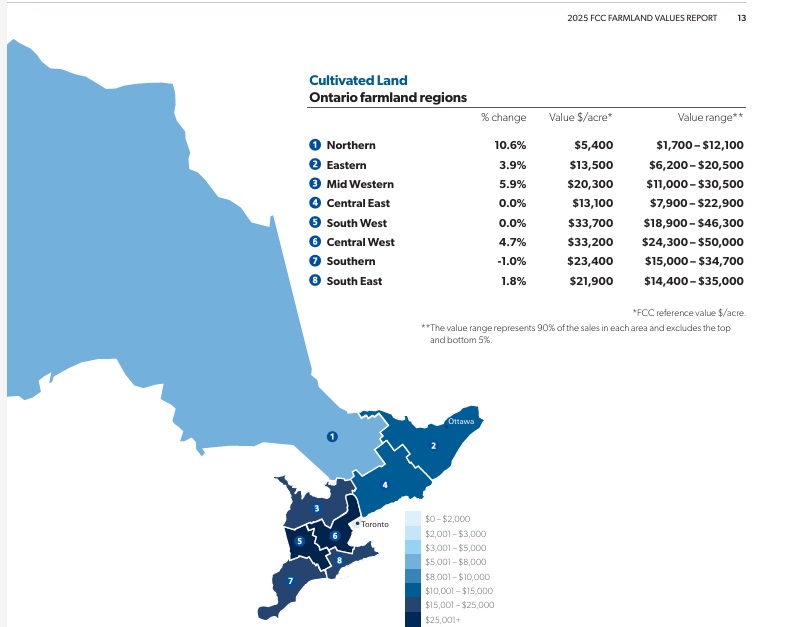
The strongest increase in Ontario was recorded in the Northern region (see map below), where cultivated farmland values rose 10.6%. FCC said the area closest to the Quebec border led the advance, with both established farmers and newcomers helping push up sales volumes and prices.
Midwestern Ontario posted the province’s second-largest gain at 5.9%, as values continued to rise despite a slowdown in migration from southern buyers. Central West Ontario followed with a 4.7% increase, supported by higher land turnover and continued urban pressure in the southern part of the region. Eastern Ontario posted a 3.9% rise, although that market had stabilized after earlier spikes tied to out-of-province buyers. Other areas were weaker. Central East Ontario saw stable values after severe drought cut yields and, in some cases, caused total crop losses. In the Southeast, values rose only about 1.8% as drought slowed transactions and buyers focused on good-quality land close to home rather than paying premiums for poorer soils. Ontario’s Southern region was the weakest performer, with average cultivated land values slipping 1%. Less desirable farms tended to sit on the market longer, and specialty operations often sold below list price, although livestock-oriented land held up better.
A separate Valco Consultants study released in late January showed farmland values across 11 counties in the southwestern part of the province increased an average of 2.7% in 2025, rebounding from a 1.4% decline the year before.