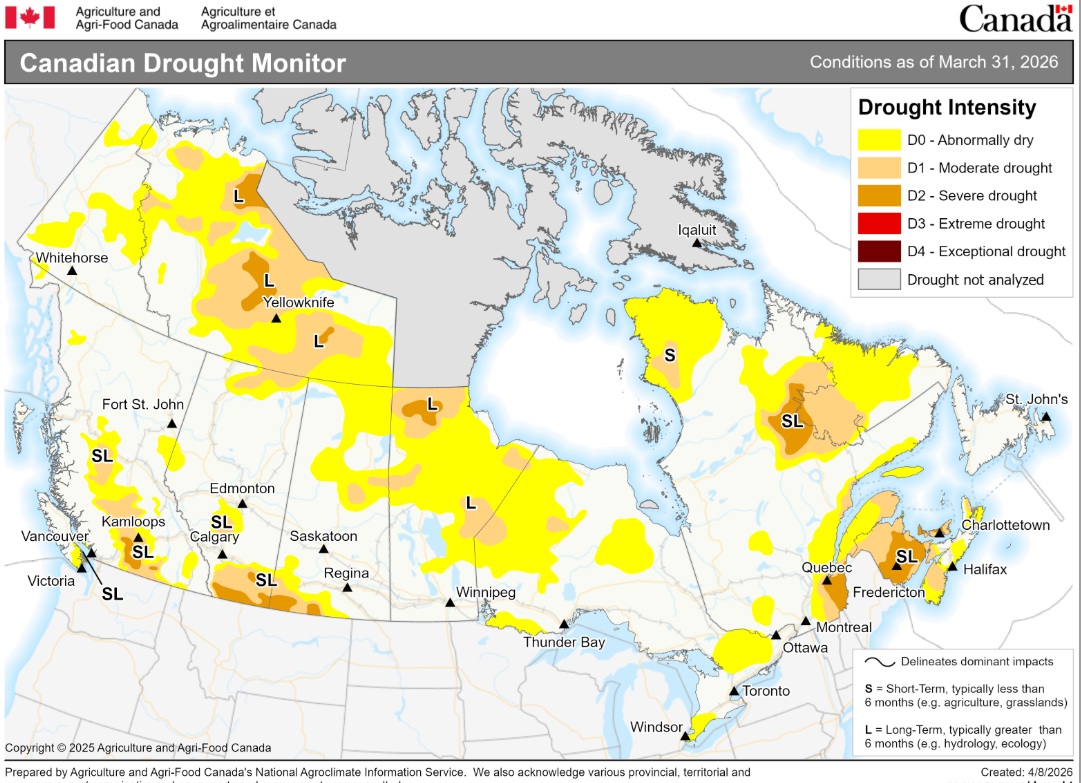
With the start of widespread spring seeding just around the corner, Prairie moisture conditions are continuing to improve.
The latest monthly update of the Canadian drought monitor on Monday showed just 21% of Prairie agricultural lands impacted by abnormal dryness or some form of drought as of the end of March. That’s down sharply from 47% at the end of February and continues a downtrend from last fall, when farmland impacted by dryness or drought hit 71% in November.
Most of the Prairies experienced near to above-normal March precipitation in March, with much of region receiving between 85% and 150% of normal, with some localized areas exceeding 200% of normal due to multiple winter storms, the monitor said. However, other areas were not as lucky, including southern Alberta, which saw only about 60% of normal.
In Alberta, conditions generally improved, especially across central parts of the province where abnormal dryness and moderate drought receded after widespread precipitation that in some places exceeded 200% of normal. The Peace River region also saw notable recovery, with pockets of moderate and severe drought disappearing. But the picture was less favourable in the south, where abnormal dryness and moderate drought eased in some areas while severe drought expanded along the southwestern border as precipitation remained below normal and temperatures stayed warmer than average. Northern Alberta posted only minor gains, with small reductions in abnormal dryness and moderate drought.
Saskatchewan saw a more mixed pattern, with both improvements and localized deterioration. Southwestern Saskatchewan experienced reductions in abnormal dryness and moderate drought, while west-central and east-central areas also improved enough to erase some previously entrenched dryness. However, new areas of severe drought developed along the southern border where precipitation deficits persisted. Moderate drought also lingered from La Ronge toward the Manitoba border, reflecting longer-term moisture shortages, while northwestern Saskatchewan saw a slight expansion of abnormal dryness after another month of below-normal precipitation.
Manitoba posted some of the strongest overall improvement in Prairie moisture conditions. In the south, abnormal dryness and moderate drought were removed altogether after precipitation reached between 85% and 200% of normal, improving soil moisture ahead of seeding. Central Manitoba also improved, with reductions in abnormal dryness and moderate drought and the removal of a severe drought pocket in central and east-central districts. Northern Manitoba likewise saw drought ease, including the disappearance of moderate drought in north-central areas and a pullback in severe drought, although some dryness persisted along the northern edge of central Manitoba where precipitation remained limited.