World wheat markets are heading into the 2026-27 marketing year with ample supplies, as record production in 2025-26 outpaced consumption growth and pushed global ending stocks to their highest level in five years.
The USDA’s monthly Grain: World Markets and Trade report on Thursday painted a bearish picture for the world wheat market, noting that global wheat production in 2025-26 rose 6% from the previous year, with especially large increases among major exporters.
Output climbed 20% in the European Union, 51% in Argentina, and 11% in both Russia and Canada. Those larger crops, combined with only modest growth in world demand, are expected to lift global ending stocks by 9%, the report said.
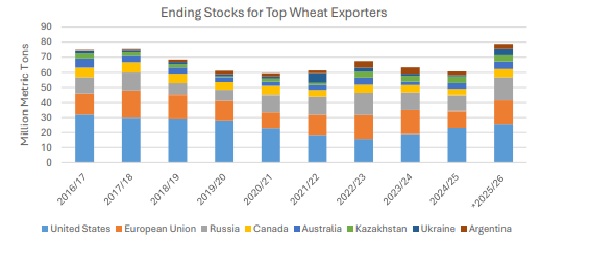
Supplies available to the export market look even heavier. Stocks held by the world’s largest exporters – Russia, the U.S., the EU, Canada, Australia, Argentina, Ukraine, and Kazakhstan - are forecast to jump 30%, reaching their highest level since 2009-10. That build-up has added pressure to wheat prices and underscored the degree of competition facing exporters.
The U.S. is expected to hold the largest stocks among major exporters, with inventories steadily rising since 2022-23 to a six-year high as export competition remained intense and domestic production increased over the past four years.
Other major exporters are also accumulating supplies. Russia, the world’s top wheat exporter, is forecast to boost ending stocks by more than 40% on the back of a larger crop. In the European Union, production rebounded sharply from the previous year’s weather-related losses to reach the largest crop in a decade, lifting stocks by more than 45% even as exports rise and imports fall. Ukraine is also expected to carry larger inventories, with reduced exports to the EU helping push stocks to their highest since the war began. Argentina, despite setting a record export forecast, is still projected to add to carryout because of its exceptionally large crop.
Outside the main exporting countries, stocks also remain burdensome. China continues to hold the world’s largest wheat reserves, while India’s stocks are estimated at 22 million tonnes, nearly triple the level seen two years ago. Together, those large inventories reinforce the view that the global wheat market is entering 2026-27 in a well-supplied, and likely still heavily competitive, position.